
Retour à la page d'accueil


The CIMA Centre’s goal is to help the children of the streets of Peru’s capital Lima. Its existence makes full sense if one looks at who these street children are, what brought them in the streets  and what they were doing before they come to CIMA.

-----------------------------------------------------------------------------------------------------

Let’s start from the beginning… Where do CIMA children come from?
Why these kids end up in the streets?

Peru: a fantastic country which is half way between myth and reality. Peru’s rich culture and natural beauty make it a tourist haven which cannot hide dramatic social disparities. These disparities results in thousands of abandoned kids who wander in the streets of a gigantic capital.


Unfortunately, Peru is facing a hard economic reality: in 2006, more than half the Peruvians live with less than 2 dollars a day and nearly one of every 4 Peruvians live with less than 1 dollar a day.
A growing part of the population (note: in 2007, one third of the population is under 14) moves from the Andes to seek a way to survive in the suburbs of Lima, to escape privations and harsh living conditions.
As a result of this, Lima now is the home of nearly 9 million people, i.e. one third of the country’s population. This overpopulation raises dramatic health and social issues and major housing challenges. Many end up in randomly-built shanty towns with limited access to water and electricity, plagued by sewage, crime and hygiene problems. Some family environments are dismantled by alcoholism, domestic violence, prostitution, drugs addiction and crime.  Under-employment compels families to have their children work. This is often a first factor putting them in the streets. Other children end up in the streets only to escape family abuse, sometimes also to sniff glue.
They live in awful conditions (sometimes in the city’s sewing network), steal to survive …and pay for glue they sniff to forget their despair. They also need to hide from the police who regularly organize raids (batidas) to drive them away of the city centre.

Nothing is more fragile than the life of these children who are marginalized, hurt in their self-esteem, weakened by diseases and drug addiction. We estimate some 400,000+ children are in this situation in Lima’s streets.
Many parents are themselves overwhelmed by their tragic conditions and passively wait for a better future. Daily fight for survival destroys these children’s self-confidence and they no longer believe in their ability to change the course of their life.


-----------------------------------------------------------------------------------------------------

top

What is CIMA, how it all started

The Centre for Integration of Abandoned Children (in Spanish, CIMA) is a non-profit organization legally registered in Peru. It was created by Jean-Louis Lebel, a Canadian sport teacher in 1989 to offer an alternative to Lima’s street children.


Jean-Louis Lebel, fondateur du CIMA

Les ruines qui entourent le CIMA

Located originally in the city centre of Lima, CIMA could only greet children during the day. It has since gained trust among Peruvian and International foundations and has welcome larger groups of children.
Today, the centre is located on a 3-acre lot, surrounded by ancient ruins and beautiful mountains.

Who are the CIMA’s children, how did they arrive there ?

The large majority of CIMA’s children directly come from the streets, although a few of these children are sometimes sent by the tribunal or families themselves.


What is a street child ?
Street children are children who live, sleep and seek their social environment in the street. These children break ties with their families and find themselves deprived from love and basic living support. Children abandon their homes for the following reasons :

  • Domestic abuse, alcoholism, insufficient economic resources or living space at home, extended absence of parents at home (parental indifference and lack of responsibility).

By living in the street, children are exposed to many threats to their physical/moral integrity and normal development. Problems these children have to face include:

  • Burglary (their belongings get stolen and they learn to steal in group themselves)
  • Strong glue (terokal) inhalation, coke and other hallucinogenic substances consumption
  • Bad food
  • Diseases
  • Street fights
  • Lack of education and hygiene
  • Cold
  • Physical and sexual abuse

These children are disturbed in the emotional and psychic development due to a clack of attention, motivation and support. Many of these children have issues with authority, are aggressive and stubborn.

Children of CIMA have history and we should know on, how to integrate ourselves with their lives and also on integrating their lives with our organisation


The bridge that connects The CIMA to
the center of Cieneguilla

The children arrive in CIMA on their own will. CIMA is known to the children on the street by "word of mouth". Because, the kids of the street either know a friend, brother or a rival  who had been to CIMA.
The founder of the center J-L Lebel meets with the children in the streets, every friday evening in order to talk to them about CIMA and to suggest alternate opportunities available to them other than the streets.

The CIMA centre: how and where do we work with such children?

The founding principles of CIMA:
How we mentioned earlier, it is clear the children would like to reintegrate society entering voluntarily the centre. CIMA offers a rehabilitation programme suited to each kid’s needs. One of the founding principle is that love should be given without conditions to each kid entering the centre so that each of them feels and knows they are loved.
As soon as they arrive, each kid is welcome in a group with which they share their everyday life. Each kid leads its own reintegration program following the interviews they will have had with the centre’s social worker and psychologist. It happens some children leave the programme but CIMA centre allows these children to later reintegrate the centre if they can explain their motives. The philosophy of the founder stresses that children needs discipline as much as love to solve their problems. This requires constant communication with the boys. Every effort of the CIMA centre is driven to raise new values among these children related to work, instead of idleness and burglary. To this end, each child is involved in the centre’s housekeeping, collective work and follows customized theoretic and technical educational programmes. Such integration through work is made to increase self- and collective-esteem to support their integration.

-----------------------------------------------------------------------------------------------------

top


CIMA, its location, its functioning

CIMA location


Far away from downtown Lima (around 1 hour), the location in an environmental district -Cieneguilla- of CIMA, allows children to break with the rhythm and the atmosphere  of their lives in the street and to initiate themselves to activities in nature. The capacity of the Centre accommodates 90 boys between 8 and 18 years old.


CIMA employees

Founding member:
Jean-Louis Lebel
Director:
Mario Lopez
Coordinator: Raquel
Secretary:
Anna Crabble Lozano

3 psychologists in charge of children rehabilitation
in their families

13 teachers helping children on a daily basis

 
Accountant: Sandra
Accountant: Elsa
Social Workers: Julia & Elisa
Sewing lady: Julia
Claudia, the cook
Felix, the cook


Teacher’s team

Music teacher
Technical teacher
Technical teacher
But as well : a teacher of woodwork, of screen printing, of art, of agriculture and fish farms, of sewing and of sport.

The monthly budget of CIMA’s functioning (maintenance of building, food, clothing for 90 children, schooling fees, medical fees, employees salaries, etc…) reaches around US$ 15 000.
Ayud’Art organisation is for now donating US$ 1000 every month for all projects. The Peruvian government helps CIMA through food donations but the Centre has to look every month for necessary amounts to cover its needs.

-----------------------------------------------------------------------------------------------------

top

The philosophy… or a few founding principles of people working with children from CIMA:

  • Win the child’s confidence by offering a particular attention in order to modify his behavior.
  • Satisfy the first needs  such as affection, accommodation, food, health, education.
  • Facilitate relationships between children through sport and art activities.
  • Establish contacts with companies (trainings) in order to allow teenagers to learn a job.


The day of a child at CIMA:

Every day of the week, the children wake up at 5.30am, make their bed followed by a cold shower. They tidy their rooms and then go to the morning meetings where they all gather together to talk about their coming activities, the previous ones and to introduce new arrivals or new volunteers, to pray or read a text, to sing the hymn of CIMA and to celebrate birthdays.

The boys then go back to their rooms where they have breakfast together They brush their teeth under strong surveillance, cheaters be careful. Around 7.20am, they prepare their stuff to go to school going there walking (3 different schools around CIMA). Each of them is attending classes corresponding to their level in a public school where the uniform is mandatory.

They come back from school around 2.00pm, change clothes, have lunch and then participate every afternoon to activities organised by CIMA such as :


Iron
Woodwork
Agriculture and fish farms
Music lessons
Art
Sport


Children who are attending school level rehabilitation or who do not go to school in the morning or go to school in the afternoon participate to common tasks in the morning such as cooking.


In the evening, children do their homework, have dinner in their rooms and depending on the availability of volunteers, can play board games or initiate themselves to IT or play soccer games.

Every day of the week is based on the same model. During the weekends, children who had good results in school can go and visit members of their family such as a grand-mother or an aunt. The other children stay at CIMA and participate to activities or go for a walk in the country side and picnic as well.


-----------------------------------------------------------------------------------------------------

The most beautiful smiles in the world, figures that keep increasing give more and more hope, the pride of having a well done job (more than 75% of the children that went to CIMA find a way to adapt themselves in school and in the society. Great projects are born (for example we did the opening in September 2006 of the Residence Estudi’Art, cousin of Ayud’Art that allows children from CIMA who obtained good results in school, to follow studies at university. The results from CIMA show that they do not need to prove their utility anymore.
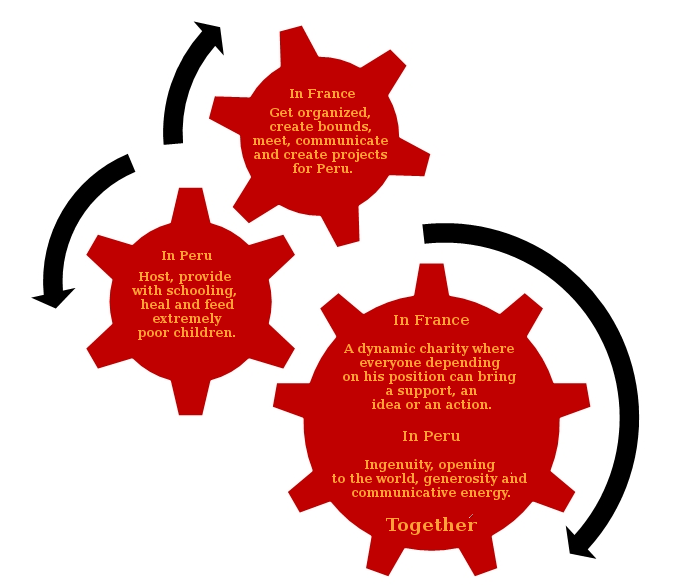
The idea and the energy from one man, Jean-Louis Lebel, allowed this success. We can still write the end of this tale which started so badly though in the middle of dangerous streets for the children who went to CIMA and it is all together that we can contribute to this today.

To find CIMA on the internet : www.cimahope.org


top

-----------------------------------------------------------------------------------------------------
- Credits - Contact us - Legal disclaimer -
Site Map -